Boxgo AI · AI Digital Employee
Founding-cohort pre-sale|Initial scope and launch timing are set by the signed order
An AI teammate that designs,
operates and executes for you.
Hand your product data, brand rules and proven content expressions to the AI Creative Agent. It works like a long-term digital employee: it produces titles, main images and detail-page slices, remembers your brand preferences, and gets better with every round of feedback. Replace repetitive manual work and speed up listings, testing and campaign asset production.
- AI designer
- Auto-generates titles, main images and detail-page slices around each SKU
- Self-improving
- Upload brand rules, past assets and feedback to make it more like your team
- Always learning
- Every review and preference adjustment becomes reusable company context
The AI Creative Agent reduces repetitive production and coordination cost. Product facts, platform rules and final listed content remain your company's responsibility.
What slows down new listings is never a single click on “generate”.
One set of e-commerce visuals usually dies in a dozen rounds of rework.
Ops says “highlight the selling point”, the designer asks “which one”. After the first image, you still need platform sizes, detail-page rhythm, titles, and a second version in the same style. You end up with loose files instead of something listing and ads teams can use.
Assets are scattered, decisions need chasing
Product shots, specs, brand rules, old files and ops experience live with different people. Nothing is packaged into one executable task.
A nice image is not a usable set
Generic image tools solve a single frame. Titles, image hierarchy, detail-page narrative and export naming are still manual.
The busier you are, the less style you accumulate
Every run starts from a blank prompt, so good past assets and proven wording never become reusable inputs.
The AI Creative Agent absorbs this repetitive production loop, leaving your team time for selection, judgement, review and testing.
Standard delivery unit
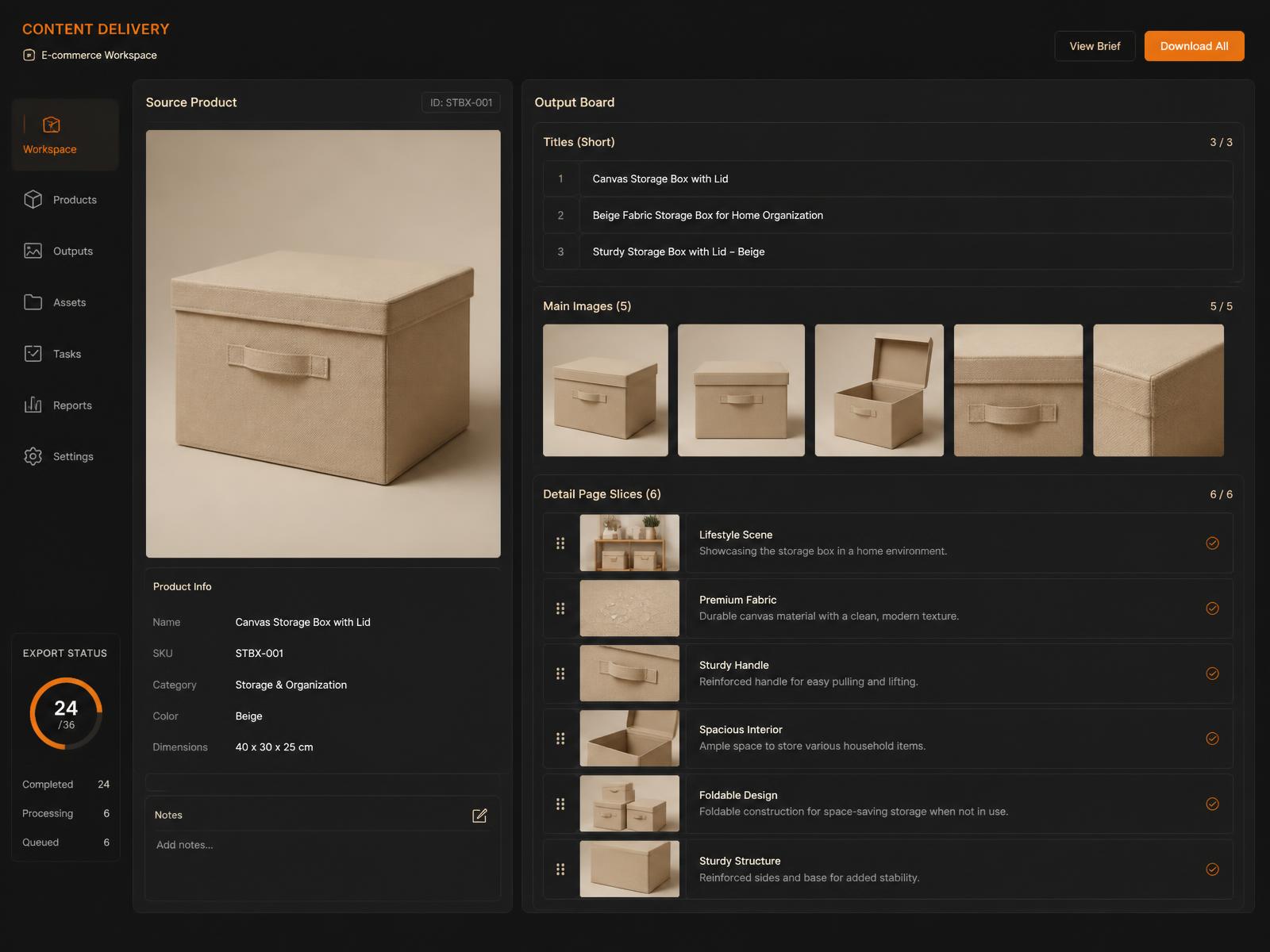
One SKU delivers 3 titles, 5 main images and 6 detail-page slices.
Everything is organised around the same product facts, channel goal and content strategy — one structured delivery, not fourteen random generations.
14 content outputs per pack
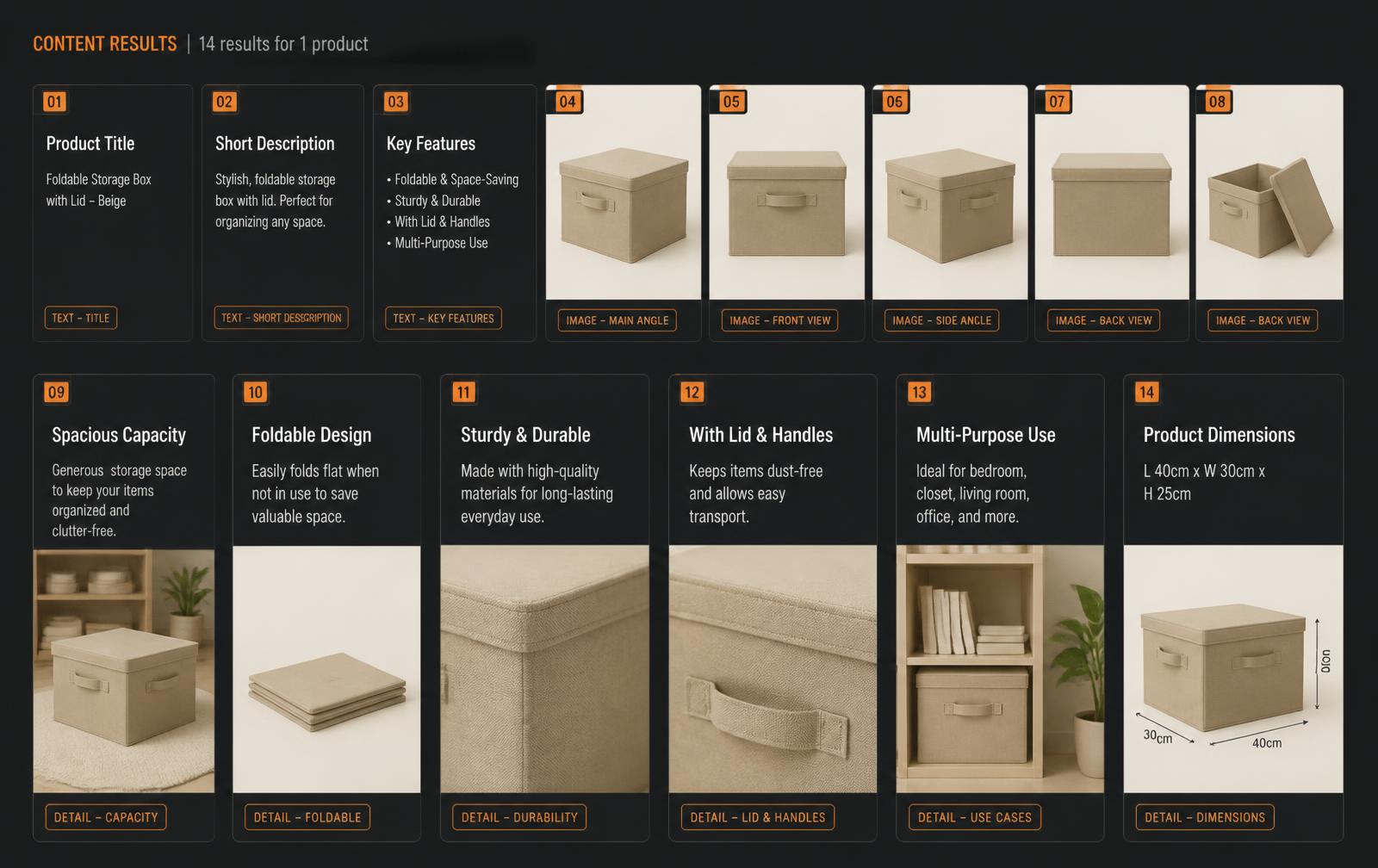
3 title directions
Search terms, core benefit, and audience/scenario. Every title maps to confirmed product facts with checkable claim boundaries — no “hit copy” assembled from unverified specs.
- Search coverage
- Benefit conversion
- Scenario & audience
5 main images
Five images never repeat the same message. Each carries a different reason to buy: product recognition, core benefit, use scenario, specs/comparison, material or trust. Layouts follow platform and category rules.
- Product recognition
- Core benefit
- Scenario & audience
- Specs & difference
- Material & trust
6 detail-page slices
Six sections answering what buyers ask: why they need it, what it offers, why to trust it, how to use it, how it differs, and what to do next.
- Need / pain
- Core benefit
- Evidence / specs
- Use scenario
- Difference / trust
- Action / service
A reviewable pack, not loose files
Approved results are packaged by folder with the product data, versions, approvals and risk notes used. The team knows why each image and line exists, and can reuse it next time.
Shown here is the standard delivery structure. Sizes, platform requirements, editable formats and delivery timing follow the selected channel, category, contract and current product version.
From product data to a finished pack
You bring the product and the judgement; the agent takes the repetitive production.
- 1
Create a product task
Pick the channel, category and goal for this launch: acquisition, conversion, clearance, product testing, or building a standard asset library.
- 2
Add data you are licensed to use
Attach product photography, packaging, logo, specs, brand rules and confirmed selling points. When data is missing, the system tells you what is missing instead of writing guesses as facts.
- 3
Choose company context and references
Select past company assets, proven content directions, permitted public competitor references, and wording you do not want this time.
- 4
Strategy first, visuals second
Title angles, the job of each of the five main images, the detail-page narrative and the risk points are settled before generation and layout begin.
- 5
Quality check and human confirmation
Product facts, copy, subject consistency, sizes, repetition and platform risk are checked. Uncertain specs or high-risk claims stop at a confirmation point instead of being invented.
- 6
Deliver as a pack, then iterate
After approval, results are organised into the agreed folder structure. Your choices become reusable company context for the next task, not a one-off chat log.
The interface shows task progress, confirmation points and delivery status only. Model vendors, keys, internal routing and system prompts are never exposed to the browser.
Product interface
From task briefing to export, the whole workflow lives in one workspace.
Real screens from the AI Creative Agent workspace: the agent execution stream, generated assets, and the final export-ready listing pack.
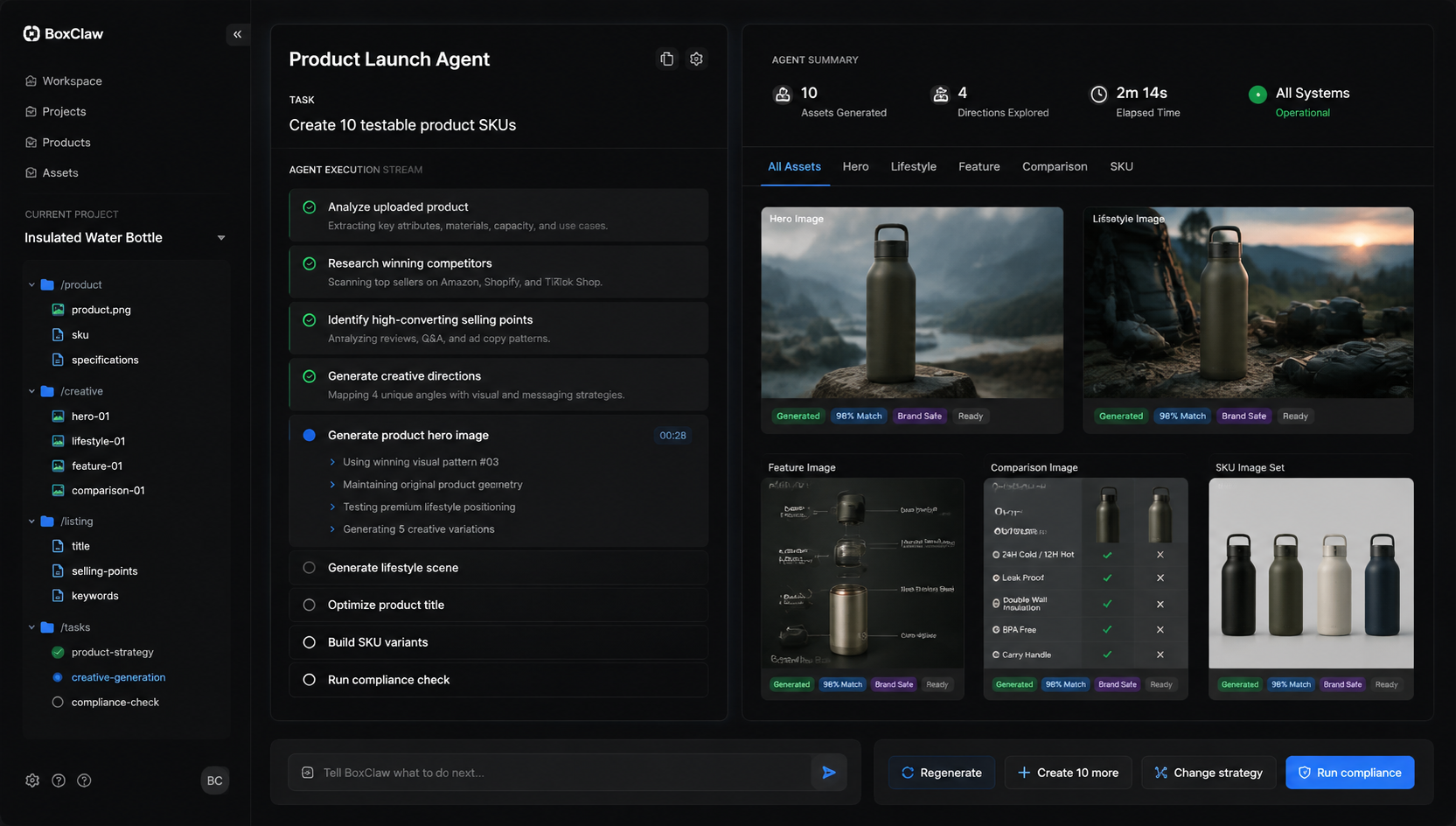
Agent execution stream
Submit one product task and watch every step run, with hero, lifestyle and feature images appearing live.
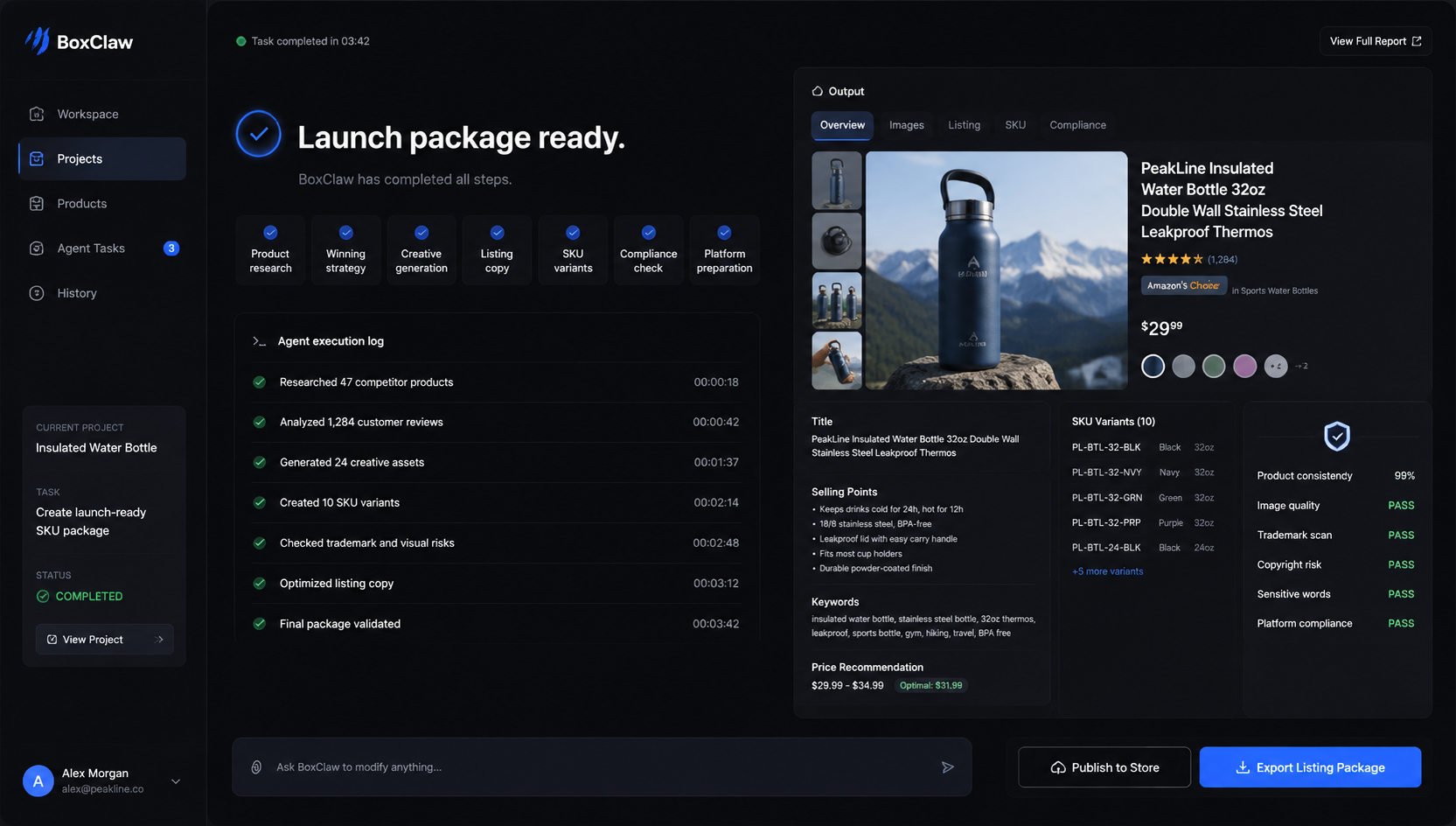
Launch package ready
Title, selling points, keywords, SKU variants and compliance checks packed together, ready to export or publish.
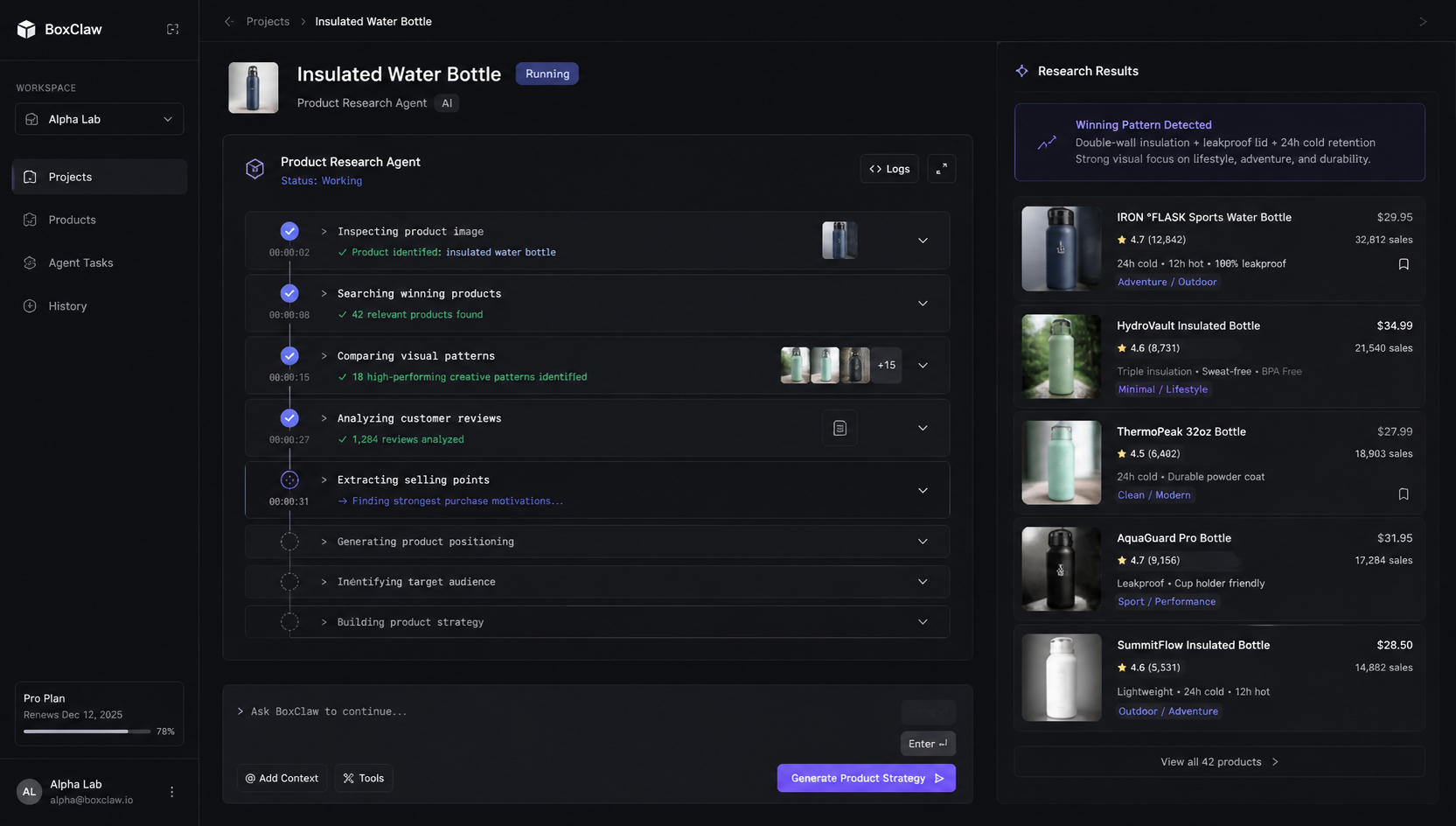
Product research results
Competitor bestsellers and reviews are scanned automatically to surface winning visual patterns and buying motivations.
Results that increasingly look like your team
Usable is not the same as on-brand. Turn “what you want” into reusable input.
The problem with most AI images is not that they look bad — they look like anyone could have made them: wrong brand feel, wrong emphasis, proven wording unused. The AI Creative Agent does not compress company experience into a vague prompt; it structures it into a selectable, licensed, traceable company context library.
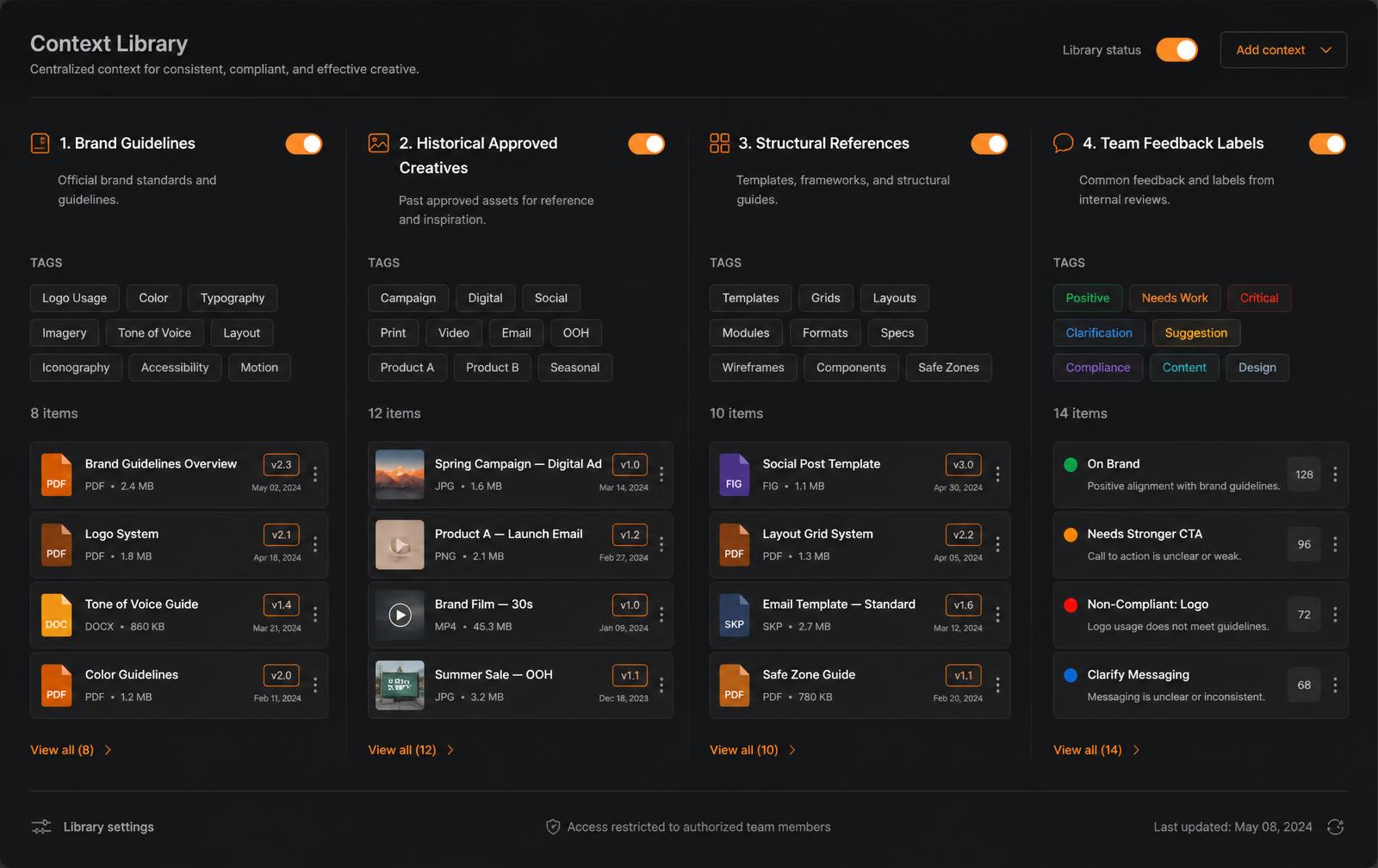
Product facts and brand basics
Product photography, packaging, logo, specs, brand colours, banned wording and official selling points.
Past company assets
Put previous main images, detail pages and layouts into the asset library as style and structure references.
High-quality / high-ROI cases
Flag assets, titles or campaign directions you have validated, so the next run reuses their structure, rhythm and benefit order.
Public competitor references
Note public pages, scenario structures or angles you follow, to understand common information hierarchies in your market.
Team feedback
Choose “closer to version A”, “avoid this”, “these benefits must come first” — review notes become reusable preferences.
“Feeding the model” should not be a messy upload box.
It should be licensed, categorised, versioned company context with switches. One task can reference validated past cases; another can reference only the current brand guide. A single upload never leaks into every task.
Only upload data you own or are licensed to use. Company assets, operational data and references are used within your authorisation for task generation and product improvement only; customer data is never used to train general models or shared with other companies without separate explicit consent. Competitor material is used for lawful analysis and structural reference only, never for replication.
Not one more model — one less production loop
Generating an image and delivering e-commerce content differ by more than a prompt.
How it starts
Generic AI image tools
Type a prompt and reroll
Boxgo AI · AI Creative Agent
Create a SKU task with channel, product facts, brand and goal
Main output
Generic AI image tools
A single image or a batch of candidates
Boxgo AI · AI Creative Agent
3 titles, 5 main images, 6 detail slices and an organised pack
Consistency
Generic AI image tools
Every image needs manual re-alignment
Boxgo AI · AI Creative Agent
The same product facts and strategy run through titles, images and detail pages
Style control
Generic AI image tools
Depends on rewriting the prompt each time
Boxgo AI · AI Creative Agent
Brand basics, past assets, validated cases and team feedback form company context
Risk handling
Generic AI image tools
Usually found by ops after the fact
Boxgo AI · AI Creative Agent
Handled upfront via product facts, risk notes, human confirmation and version records
Delivery
Generic AI image tools
A folder of unnamed downloads
Boxgo AI · AI Creative Agent
Organised by checklist, version and folder for review, testing and listing
How value is judged
Generic AI image tools
“Does this image look good?”
Boxgo AI · AI Creative Agent
“Did this pack cut repetitive work, and is it worth another test round?”
We do not treat “one pretty image” as delivery complete. For an e-commerce team, complete means it enters the workflow.
Platform rules and content risk
AI images are not automatically throttled — but platform risk cannot be left to luck.
There is no public, stable rule that AI images are always suppressed on every platform and category. Review, recommendation and ad policies keep changing. What actually needs managing is content sameness, false or exaggerated claims, copyright/trademark/likeness risk, mismatches between product and image, and the click and conversion loss caused by low-quality content.
Sameness and low quality
Identical templates, similar frames and vague benefits quickly lose distinctiveness.
Multiple content routes built around different reasons to buy, with batch and test labels so the team can judge which version deserves more spend.
Product and content mismatch
A wrong spec, size, material or claim is more than a review risk.
Claims trace back to confirmed product facts; missing data triggers a prompt to supply it, instead of turning an AI guess into a product promise.
Rules keep changing
Rules differ by platform, category and time; what works today may not work later.
Rules and human-review entry points are kept per platform, category and date. High-risk content stops at a confirmation point; we never promise to bypass review.
The AI Creative Agent makes content production more controllable, reviewable and testable. It does not offer ways around platform moderation, and it does not promise guaranteed approval, zero throttling or fixed ROI.
Listing, advertising and moderation follow the rules in force on the target platform at that time. Platform rules, category limits and ad policies are decided by the platforms, and your company remains responsible for published content.
Why the AI Creative Agent
Turn repetitive production from constant chasing into a manageable content pipeline.
Complete delivery, not a single image
Titles, main images and detail slices grow out of one product task, cutting rework between ops, designers and agencies.
Results that look like your company, not a template
Brand assets, validated cases and team feedback become selectable context, so style is reproduced by design rather than by luck.
Risks surfaced before decisions
Missing product facts, sensitive claims, risk items and confirmation points are never hidden later in the flow.
Output your team can also learn from
Every pack becomes a starting point for review, A/B testing, asset reuse and strategy discussion.
It does not replace taste, product selection or brand judgement. It replaces repeated layout, size adaptation, asset hunting, batch extension and file wrangling.
Run the numbers with your own costs
See how much repetitive production costs your team each month.
No need to trust a one-size-fits-all savings claim. Enter your real labour cost and time per pack to estimate the repetitive capacity a standardised process can free up.
Salary, benefits and overhead as estimated by your company
Average time from gathering assets and layout to exports and revisions
The plan releases 20 per month; enter any value to model your case
Product selection, taste, photography, review and campaign judgement do not count as replaceable
Used to convert monthly cost into an hourly rate
This is an estimate based on the workload and labour cost you entered — not a promise of profit, headcount reduction or ROI. It excludes photography, licensing, media spend, review rework, platform fees, designer strategy work and unused quota.
Beyond the standard pack — build around your process
Your categories, asset library, approval chain and data have their own rules? Customisation is possible — with a clear scope first.
The standard AI Creative Agent covers one general content delivery flow. For companies with fixed category templates, internal review, brand asset libraries, PIM/ERP, campaign data or multi-role collaboration, we can build on top of the standard capability.
- Category-specific templates
- Company brand & asset library
- Approval, permission & delivery flow
- PIM / ERP / campaign data APIs
Custom development is not included free with the $4,980 annual plan. We first confirm data ownership, integration conditions, approval responsibility, delivery standards, timeline and budget, then propose a project plan.
Book an enterprise discussionFounding-cohort plan
Start with one year of standard quota and move from “never finished” to a steady delivery rhythm.
AI Creative Agent
Includes 240 packs per year, released as 20 per month, accumulating until the end of the service period.
- 3 platform titles per pack
- 5 product main images per pack
- 6 detail-page slices per pack
- Organised around the same product facts and channel goal
- Founding-cohort feedback goes first into the roadmap
The standard product does not include unlimited manual design outsourcing or company-specific development. Final scope, timing, quota and refund terms follow the signed order.
Built for teams launching and testing frequently
- A steady stream of SKUs needing titles, main images and detail assets
- No desire to restart from blank prompts and scattered files each time
- Existing product data, past assets or content judgement worth turning into company assets
- Willing to keep human confirmation instead of leaving platform rules and product facts to a black box
Not a fit if
- You want one-click competitor copies or ways around moderation
- You have no product data and will not confirm product facts
- You need unlimited manual design outsourcing or immediate large-scale bespoke content
FAQ
Delivery, quota and platform rules
Founding-cohort application
Start with one of your SKUs and make the delivery standard concrete.
Tell us your category, channels, current content production setup and monthly launch volume. Our business and product teams will assess fit for the founding cohort, then confirm pilot data, delivery scope and pre-sale terms with you.